Friday, May 18, 2012

What is food to one, is to others bitter poison.

My sources tell me that's Lucretius.

Canada got a visitor earlier this week from the UN.  He had some harsh things to say about Canada's food supply, poverty, and obesity.  Nothing he said strikes me as unreasonable.  Many Canadians eat bad food, many Canadians are poor, and many Canadians are overweight.

Canada's Strong Stable Majority Conservative Government© was pretty fucking pissed about this "snooty Harvard-educated multi-professor of judicial fantasizing" coming by and offering his two cents (which may have to become five cents, as we are phasing out the penny).  To be fair, these were not the words of our Strong Stable Majority Conservative Government©, but rather the words of a journalist with Sun media. (Go ahead and read the whole article.  It's quite awesome in its staggering arrogance, indignation, and chutzpah.) Our government was much more reasoned in its response from Heritage Minister (are poverty, food security and obesity part of his portfolio?) Jason Kenny:

Immigration Minister Jason Kenney called it a waste of UN money to investigate developed countries like Canada.
“It would be our hope that the contributions we make to the United Nations are used to help starving people in developing countries, not to give lectures to wealthy and developed countries like Canada,” he told reporters. “I think this is a discredit to the United Nations.”
Kenney dismissed De Schutter’s mission as a political exercise, saying the UN’s own figures rank Canada as one of the best developed countries in the world. (Toronto Star)
I guess that being a developed country means that obviously things are peachy keen here in the Great White North, under our Strong Stable Majority Conservative Government©, and, as much as they might be loathe to admit it, they probably under Canada's Previous Corrupt Cronyistic Secretive Adscam Liberal Government.  That there is nary an overweight person to be seen.  That we don't have any poor people, and even if we did, they'd eat like kings.  That it's not hard to afford good, healthy, nutritious food on a budget.  That this kind of nonsense is an insult to Canada's Strong Stable Majority Conservative Government©.

In my humble opinion, the fact that Canada is a developed country does not make these sins of indifference nonexistent.  They make them worse.  We are relatively wealthy.  We are blessed with an abundance of natural resources.  We are big, and temperate, and have more fresh water than any other nation.  And we still have poverty and food insecurity.  We are investing our wealth not in people, but somewhere else (gazebos, maybe, or imaginary jets, or luxury hotels, or overseas, or wherever the hell our money is going).  We are paving over our natural resources, growing suburbs on our farmland and box stores in our orchards.  In countries torn by war, or famine, or drought, or disease, this kind of thing is regrettable, but understandable.  Our stance should not be righteous indignation, but rather humility and an admission that we can do more, and are letting each other down.

A friend of mine said that the response to this report revealed the CPC as "irredeemable".  She's probably right, although I think it's worse than that.  Whatever they are, they're horrible, horrible people.

Tuesday, May 15, 2012

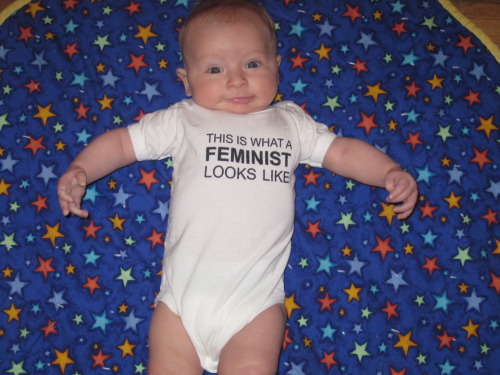
This is what a feminist looks like.

I have the same shirt.  Except mine is obviously much (much) bigger.

I don't really look like a feminist.  Not what you'd expect, anyway.  Not all the time.  First of all, I'm a man.  Also, I'm a big man.  Also, I'm a big man with a shaved head.  Not typical.

Unless you see me with my daughters.  Then, maybe, I look like a feminist.

It wasn't my daughters that made me a feminist, though.  I've considered myself one for a long time.  Maybe part of it is liberal guilt.  If so, I'm okay with that.  It puts me on the side of the proverbial angels, so you should be, too.  But it doesn't take being the father of girls to recognise that women have, historically, and figuratively, be screwed.  Or that they still are, figuratively, screwed.  Or that something ought to be done about it.  Or that *I* can do something about it.  Is that liberal guilt?

It doesn't take being the father of daughters to realise that whatever progress women have made and will make is a) not universal (I'm looking at you in particular, Saudi Arabia, but you are not alone), and b) not safe and c) not certain.  Here, in the west, the right to contraception is still debatable. Here, in the west, the inviolability of a woman's body is still being negotiated.  Here, in Canada, women are not allowed to protect themselves if they are vulnerable because they are a sex worker.  And here, in Canada, we are still trying to figure out not whether or not a woman should have an abortion, but whether or not the option should be available.

Let me deal with the obvious.  If you want to prevent abortions, which you probably should want to do, then the best way is to provide women (and men) with sex education and access to affordable contraception.  And since women will still get abortions even if they're illegal, and you are actually concerned about people, and not about punishing sexually active women, then abortions should be safe, and therefore legal.

And since prostitution is commonly called the world's oldest profession, then it's safe to say that prohibition isn't working, and again, if you want to protect women, rather than punish them, then sex work should be safe, and therefore legal.

But beyond that, no matter what you believe about women, or about sex, or about abortions, if you believe in, as much as is possible, freedom, then you are, and ought to call yourself, a feminist.

Freedom is a small, trashy, flashy and overused word.  I hate to use it, because hateful men like to throw it about.  And they lie about it.  And they use it when they mean something else.But the idea is a good one, when considered, and reasoned.  What I mean by it is self-determination, as much as is reasonable.  And self-determination is what I want for all people.  And for my daughters, in particular.

The world is a harsh and ugly place, full of hateful and ugly people.  A gamed system has ensured we'll compete with each other rather than cooperate (and that's something I will address later, if you're good).  It has made sure that we'll take any advantage we can, and exploit the disadvantages of others.  In the past, sadly, being a woman has been a disadvantage when it came to self-determination.  In many places, it still is.  And here men (and women) are trying to make it so again. 

Life for my girls, for all girls, will be hard enough.

Thursday, April 5, 2012

Introverts and God

I was just listening to Tapestry on CBC on my way home.  It's an episode about introverts and the religious tradition, and now.  If you want to, you can listent to it here.  It's about 25 minutes in when they get to what I'm talking about.

What they talked about was the fairly modern evangelical tradition and its emphasis on the salesmanship of spreading the gospel.  It's tough for introverts, they say, who are evangelicals, because it's hard to go out and sell Christ to someone, and to close the deal, and to share your testimony.  And there's a great emphasis on all of that, and introverts most likely aren't as successful as extroverts.

And Mary pointed out that it's odd, because really, all the great religious figures, and not just christian ones, were often solitary.  And there's a great religious tradition of religious figures being quiet and alone.  Jesus went into the desert.  Buddha went into the woods.  Moses went into the desert.  Joe Smith went into a cave.  L. Ron Hubbard went into his office.

Well, Mary, I just want to say that I don't think it's odd at all.  And the explanation is very simple.

Those religious figures used/needed solitude to uncover truth, to find the answers, to speak to god (or whatever), and to provide lessons to bring back to others.  Evangelicals think they have the answers.  They don't need 'em.  They don't need thinkers.  They need salesmen.  And there's the disconnect.

Maybe it's one of the reasons I find evangelicals so distasteful.  There's no contemplation anymore.

Saturday, March 31, 2012

Prejudice is opinion without judgement.

That's Voltaire.

Trayvon Martin was not a saint.

I suppose it seems obvious.  It is obvious.  However, here I am, a liberal, saying it.  Some on the right would have you believe that we're already petitioning the pope to have the requisite miracles documented.  He was not a saint.  I know hardly anything about the kid, but I know that he was sometimes rude, sometimes disobeyed his parents, was mean to his siblings, and he didn't always do his homework.  He was not always a good kid.

I don't know much about this.  Here's what I know for sure: a kid walking back from the store was shot by a man with a history of probable mental illness, and the police in the community decided it was likely self-defense.

This shouldn't have become politicised, but it did.  We should not be lining up along ideological lines on this situation, but we are.  A kid got shot by a man, and the "lefties" are blaming the man who shot him, and the "righties" are blaming the kid who got shot.

What are they blaming Martin for?  A bunch of things: wearing a hoodie, being in the wrong neighbourhood at the wrong time, hiding his hands, even attacking the man with the gun.  What's Zimmerman being blamed for?  Shooting an unarmed kid.

Obviously, since this has become a political issue, the blame and the dialogue has expanded.  People are wearing hoodies in solidarity, and columnists (I suppose including myself now, though I have no column) have expended billions of pixels in commenting (as is their wont).

My favourite columnist is no exception.

The most important thing that Michael Coren says about the Trayvon Martin brouhaha doesn't come until the last paragraph.  However, I feel I should bring it to your attention first:
I have no idea whether Trayvon Martin was a victim or an instigator...

He has no idea, but he is willing to side with those who claim he's an instigator.

A few days ago, I wrote about ad hominem attacks.  I said that when you insulted others, you were essentially admitting your argument was weak.  Today's Coren column is exceptional in one regard.  He doesn't bother being subtle in insulting who he perceives as his opponents:
  • Let’s try to make this as simple as possible, even for liberals. (translation: liberals are stupid)
  • ...the usual race pimps and inverted racists, such as Al Sharpton (Al Sharpton is a racist)
  • ...the increasingly hysterical and exploitative President Barack Obama (Obama is exploiting a dead kid when asked in a press conference for comment)

I find it very hard to talk about Michael Coren without resorting to these kind of attacks.  His writing gets under my skin.  He frequently insults atheists, liberals, environmentalists, and pacifists.  I am all of those.  It feels like he's insulted me first, so it's fair to lash back.  But once again, if I do, he wins.

His opinions are odious.  His writing is often weak and rambling.  He tends to substitute venom for passion.  His research is sporadic.  His examples are sometimes misleading and dishonest.  He's fond of inequal comparisons (such as pointing out that Shawn Tyson killed some people, so Trayvon Martin was clearly dangerous).  His views on history are questionable.  He likes to insult people who disagree with him.  His behaviour and writing are also achingly parochial and tribal (I'm not a fan of Islam or Protestantism, but I also don't have the arrogance to claim that my brand of monotheism is obviously right and good), insulting other faiths with impunity, especially Islam.

The rest of his column is what you'd expect from Coren: inflammatory, derogatory, revisionistic, and trying to be clever in labelling those who cry racism as racists.   Oddly, he tries to call liberals racists without actually calling us racists.  It seems an odd place to draw the line.  But I don't claim to understand him.

Please note:  I did not once insult the man.  I've staked out my small piece of the moral high ground.

Said moral high ground is slippery with the mud that others fling at us.  The gutter that surrounds us is slimy and provides ample ammunition to those that would have us join them there.  Please, let's watch our footing.

Friday, March 30, 2012

Some editors are failed writers, but so are most writers.

That's T.S. Eliot, who, as an English student and English teacher, I feel should have stuck to Cats.

It's also not very kind, but there it is.  The unvarnished truth.

Guess what I did today.  I gave up.

Terry Goodkind beat me.  It took eight books (yes, eight books), but eventually I just ran out.  The idea that I had at least three more books (turns out there are eleven books, plus a prequel, in the series) was just too much.  I just couldn't take any more.

It's harsh.  And Terry, and fans of Terry, I'm sorry.  You failed.  You tried admirably, but you failed.  But more importantly, you were failed by others.

You had an editor.  You should have fired him/her.  This was the person who should have said, "Terry, you're repeating yourself.  Terry, you're too wordy here.  Terry, you used the word mud in eight consecutive sentences here.  Either use a pronoun or a synonym."

You had a publisher.  You should have found a new one.  One who would have asked you to cut a couple thousand words (or more, way more) from your books because then they'd have cost less to print and they still could have charged eight or ten or twelve bucks for the same paperback.

You had fans.  They should have been discriminating.  Fantasy readers aren't idiots.  Most of them recognise good writing.  They read well-written fantasy.  They read well-written sci-fi.  They read well-written newspapers, magazines, comic books, horror, biographies, YA fiction, romance, classics, poetry, etc. etc. etc.  They should have know that what you were doing was stilted and awkward.  They should have known better.

You had guys like me.  Guys who were going to stick it out from sheer perverse stubbornness.  And really, I should have known better.  I knew those books weren't going to get any better.  I knew that your habits would only get worse.  I knew that what had seemingly worked for you would be ingrained by now.  You'd had plenty of positive feedback.

Now.  My excuses.  I didn't pay for these audiobooks.  I *gasp* stole them.  Sorta.  I downloaded them from a piracy site.  I had nothing invested in them except my bandwidth.  So why did I take it so far?  Stubbornness.  Also, I listened to them at work.  My time was already spoken for.  I wasn't wasting it by listening to this crap.  And the attention I was giving to these books wasn't much, and what I was giving wasn't valuable.  I could also drop out and get back in without having felt that I'd missed anything.  I don't feel that way listening to the Game of Thrones, or James Bond, or The Hitch Hiker's Guide to the Universe.

Terry, it's been a slice.  I appreciate all you've done for me (which, admittedly, is very little).  Write something else.  Get a new editor.  I'd be happy to give you another shot.

Thursday, March 29, 2012

The Argument from Intimidation is a confession of intellectual impotence.

That's Ayn Rand.  Yeah, that Ayn Rand.  The one who fled Stalinist Russia and became a sort of proto-libertarian.

However, in this, I think, she's right.

It might be because it's not an original idea: a Chinese proverb apparently says, "He who strikes the first blow admits he's lost the argument."  Joseph Farrell, a contemporary of Rand's, said, "If you go in for argument, take care of your temper. Your logic, if you have any, will take care of itself."

They all essentially argue against the ad hominem attack.  Name calling being the first, and most juvenile step, and progressing sometimes as far as violence.   Most of you know that ad hominem means "at the man".  And it does, essentially, mean that you have lost the argument.  Because you are no longer arguing.  You're fighting.  You are no longer trying to convince your opponent.  You are bullying.

The immediate inspiration for this is the comment threads on the columnists of Sun News.  Now, if you don't already know, if you haven't read my other blog, I am not a fan of Sun Media.  It is... well, you know what it is.  If you don't, here's a link.  What I can say without devolving into ad hominem attacks myself is that they seem to spend an awful lot of time bitching about the CBC.  (Today they must all be creaming their tighty-whities, knowing that the government has cut CBC's funding, thereby weakening their "competition".)

What upset me was the comments from the probable "lefties" on the site.  My people.  The people who are fans of human rights, worriers about climate change, supporters of the idea of community, and believers in progress.  They didn't even bother to refute what the columnist had written.  They didn't talk about his arguments (which were specious), or about his evidence (which was non-existent), or even of the structure of his column (which introduced extraneous subjects and then almost used them as evidence, but didn't really).  This is what they said:

"YOU'RE READING THE SUN YOU MORON! YOU'RE AT THE KIDS TABLE"

To be fair, the commenter wouldn't convince anyone of anything.  We simply don't think that way. We know what we know, and we're not likely to change our mind based on anything as ephemeral as evidence, or reason, or logic, or a well-crafted argument.  We accept what bolsters our opinions, and disregard the rest.  Makes sense.

However, that doesn't mean we stop trying.  Seriously.  And lefties?  We're winning.  We ended slavery.  We got votes for women.  We got gay rights.  We got lead out of gasoline.  We stopped the residential schools.  We got the weekend.  We stopped child labour.  We wrangled several flawed but working democracies.  We got gay marriage.  We got interracial marriage.  We ended segregation.

We're kicking ass.

And I had thought that part of the reason that we were kicking so much ass is that we were using reason and logic to wear the other side down.  And maybe it's because we are.  We don't have to resort to name calling because we're winning.

And we all know Godwin's Law, and maybe you've heard about my corollary (found here).  In fact, McKenzie's Law was based on my experience that the other side tended to Godwin before we did.

But maybe it's not true.

Are we just as bad as they are?  I'm prepared to accept it if we are.  I'd rather we weren't.  We're winning.  And we're winning because we're right.

And hey, I'm not saying don't get angry.  Angry fuelled the marches in the Civil Rights movement.  Angry got the US the Nineteenth Amendment.  Angry started the Stonewall Riots.  Angry, paired with righteous, wins.  The problem with angry is that it can get away with you.  And when you're too angry, you can lose focus, lose your capacity for reason, and you become a monkey flinging poo at another monkey.

Let's try not to be monkeys.

Today's budget day.  It's been a hard few years for liberals.  A hard dozen budgets or so.  The UK, the Eurozone, Greece, Italy, the US, Canada, Ontario, BC... they've all equated austerity with prosperity.  They've all decided that less government means more everything else (and on some things, like inequality, poverty, crime, they're probably right).  If we want to let them claw back some of the progress we've made on many issues (just as they're doing in the states with reproductive rights, or here in Canada with environmental protection, or they're doing in the UK with social programs), then we can go ahead and call them fascist, or children, or bullies, or evil.  Once we do that, they know we're not arguing anymore.

We're fighting, and they're winning.

Wednesday, March 28, 2012

I always finish the book.

Always.  (Well, almost)

When I was in high school, I was assigned Wuthering Heights.  Tried to read it twice.  Failed twice.  Later, as an ESL teacher, two of my students decided that they wanted to read Wuthering Heights. Having never read it, and working full time as a house painter while I taught, I had no time (nor inclination) to read this book. So I downloaded an audiobook, and finally made it through the damn thing.

I always finish the book.  Always.


Incidentally, those kids hated the book as much as I and decided to read something else.  Frankenstein, if I recall correctly.  I wasn't mad.  I had finally finished the book.

I also always finish the series.  Almost always.  I read all the Narnia books though they were preachy and predictable and derivative and fond of deus ex machina and general suckiness.  But I finished the fuckers.

I'm reading Westerfeld's Leviathan books.  Loved Pullmans Golden Compass books.  Read the Hitch Hiker's Guide to the Galaxy every five years or so.  Also read all the Night Watch Books.  And Encyclopedia Brown when I was a kid.  You get the picture.

There have been exceptions.  Some quite surprising: Clive Barker, for instance.  Others make sense: history books, philosophy texts, collections of short stories, collections of essays.  These are books I dip into, or take what I need, or read until I'm exhausted or angry.  And eventually, I finish most of them.

One of the best things about my job is its solitude (Stay with me. I know what I'm doing.)  When I get to work, I say good morning, assess my situation, and turn on my iPod.  On an ideal day, that good morning is the last thing I say to anyone until the family gets home at night.  I listen to a lot of music, a lot of podcasts, occasional radio drama, and a lot of audiobooks.

I've listened to some great stuff while driving: Ian Fleming, George R. R. Martin, Douglas Adams, and Tina Fey, for instance.  Librivox, the library and occasional piracy has been good to me.

I've also listened to some crap.  And I don't know why.

I can't fucking stop.  And I don't know why.

Terry Goodkind is not a bad storyteller. His story is fairly compelling, and some of his characters are admirable and interesting.  His villains are not one-dimensional.  His heroes are not completely virtuous.

But holy shit this guy needs a competent editor.

I'm not saying I'm great or that my writing is flawless.  And I clearly understand the uses of the narrative devices of repetition and parallel structure.  And I admit that I am prone to rambling and diversions.

Goodkind is prone to repetition and unnecessary explanation.  His characters stumble to deduce the obvious and to accept the evident.  The protagonists are as sneaky as four-year-olds, and still manage to outsmart the bad guys (who seem incapable of understanding that good guys are ever sneaky).  The dialogue is usually stilted and speechy, with characters launching into great monologues in the middle of arguments, while the others sit mute.  They also repeat themselves, ask rhetorical questions (over and over), and explain to each other things that they should already understand (which is, I know, a less obvious way to explain it to the dimmer reader).  The jokes are weak and prissy, even among soldiers.  And everyone seems to be a prude, which irritates me more than even I can understand.

Furthermore, Goodkind is preachy and prone to clumsy allegory.  The bad guys in these books, the Imperial Order, are clearly communists, which seems a silly bogeyman even to a guy who has read/listened to all the James Bond books two or three times each.

And I can't fucking stop listening to these terrible, terrible books.  And I can't understand why.

Part of it, I'm sure, is the story, which as I said is not bad.  But most of it, I suspect, is stubbornness.  I'm not going to let these books, these wooden characters, this juvenile prose, and this goofy conservative narrator beat me.

Because, goddamn it, I always finish the book.

Always.

(This has been an experiment.  I've written this on my phone while my computer was otherwise occupied.  I apologise for formatting irregularities and spelling mistakes or typos.)

Sent wirelessly from my BlackBerry device on the Bell network.